How to make ISK in EVE without grinding: lazy trading from ready-made picks
An honest walkthrough for the lazy: how to earn in EVE without spending your evenings grinding or risking a multi-billion Marauder. The raw market data is free for those who like to dig; the ready-made “what to buy” picks are paid. Screenshots show how both halves work and why the subscription pays for itself in a couple of days.
Key takeaways
- There are two paths to ISK in EVE: the curious dig through the data themselves (free), the lazy pay for a ready “what to buy” answer. Mercator splits the service exactly so — raw market data is free, the picks are paid.
- Station trading pays for capital, not for time and risk: orders fill while you are offline, and unlike grinding in a Marauder there is nothing to lose — you never undock.
- The paid “What to buy” page computes a score (risk-adjusted ROIC/day) and position size for you, and shows order-book skew — how much actually gets bought and sold, which competitors do not have.
- The 1B/month subscription pays for itself in a couple of days: on a real account, from a 5B start, a few days produced ~2.3B net after every fee including the broker fee (the analytics shows “net” before broker). Profit scales with capital.
Two kinds of players: the tinkerer and the lazy one
Roughly speaking, there are two kinds of people in EVE. The first — the one with plenty of time and curiosity — likes to dig through the numbers himself: open the market, sort it, compare across hubs, find his trade by hand. He’ll never pay for a tip — not a billion, not ten million — because the whole thrill is in finding it yourself. And he shouldn’t: all the raw data he works on is free in Mercator, with every metric. Dig away.
The lazy one (hi, that’s me) won’t bother. I begrudge the evenings spent poring over tables — easier to pay for a ready answer: “buy this, this many units, sell it like so.” In my whole EVE career I never honestly grinded a single billion: I stole, I shot people, I paid CCP for PLEX. My time is worth more than dull grinding. If you’re the same — this guide is for you, not for trade whales with trillions (I have nothing new for them) nor for newbies with no ISK.
Why trading beats grinding: you’re paid for capital, not for time and risk
Any PvE farm pays for attention: stop flying and the ISK flow stops. Income is hard-tied to hours on screen and doesn’t scale — you can’t farm more than you physically sit in the game for. Trading works differently: your orders stand and fill while you sleep, work, or lose a Rapier. Income is capped not by your hours but by capital and the quality of your decisions — double your bankroll on liquid items and you’ve roughly doubled your profit without spending a minute more.
And the thing people forget: grinding always carries the risk of dying. A multi-billion Marauder catches a gank in high-sec, a disconnect in a bad room, a hotdrop in null — and hours of farming zero out from one lapse. In station trading you never even undock: nothing to gank, nothing to lose in the hold, no insurance needed. Capital doesn’t explode — it just shifts from ISK into orders and back. For the lazy player it’s perfect: income with no grind and no risk of waking up without a ship.
Free: Market — everything is already computed, only the decision is yours
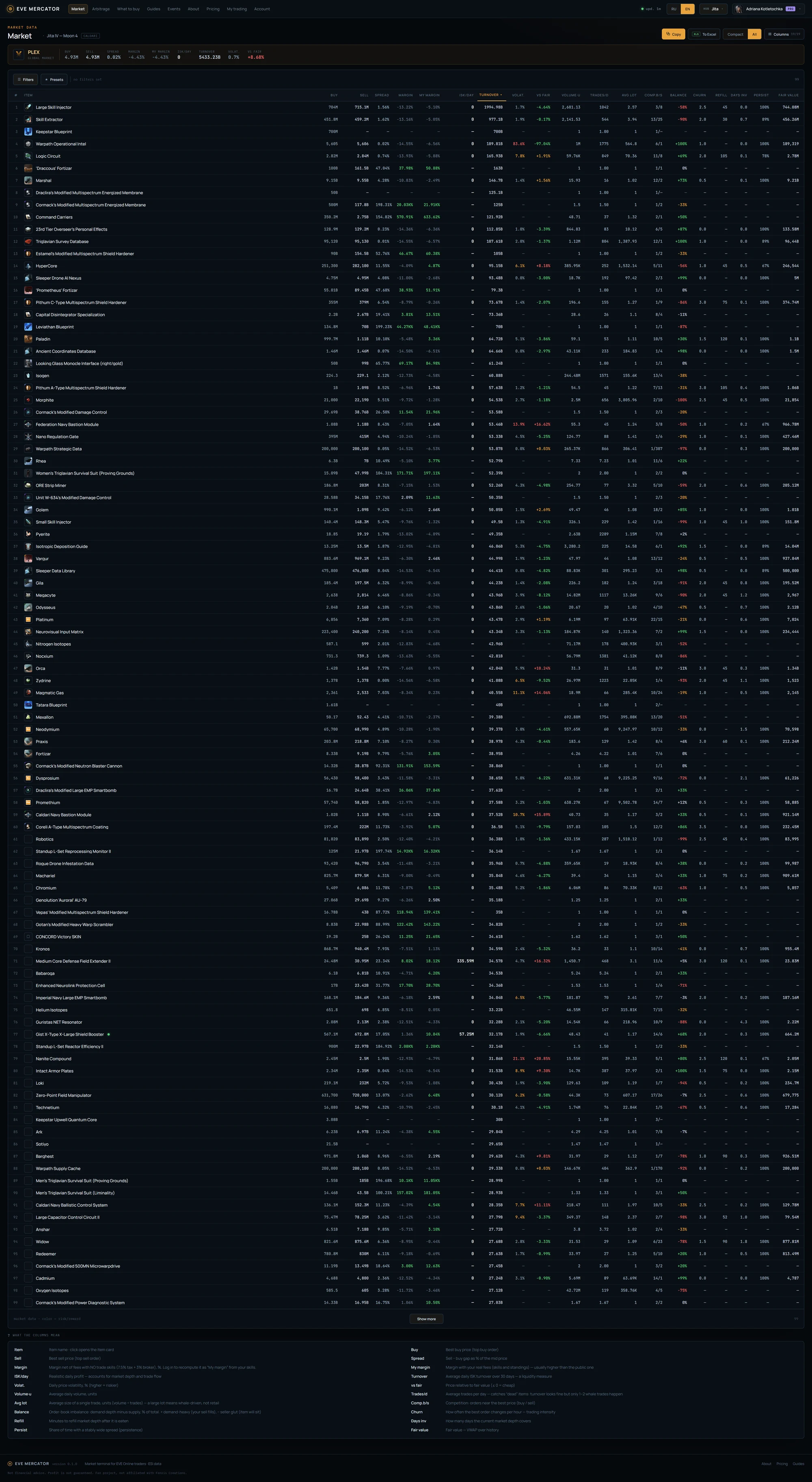
Market is a terminal over every liquid item across the five hubs (Jita, Amarr, Dodixie, Rens, Hek). Net margin after fees, spread, turnover, trades per day, average ticket, competition, volatility, fair value and the deviation from it, days of inventory and spread persistence — all computed live on fresh ESI snapshots. Sort by turnover, filter by category, and there’s your full market picture without a single ISK of subscription.
And the free Market does several times more than the game client. The client gives you only the raw material: the book of buy and sell orders, the average price and the history. Everything else — margin after fees, turnover, volatility, fair value, order-book health — the client doesn’t compute, and Market does, for free. So even in the free half most of the work is already done for you; anyone who enjoys digging just picks the positions and builds the basket by hand. There’s no secret behind a paywall here: the data and the metrics are identical for everyone.
The item card: all the depth, also for free
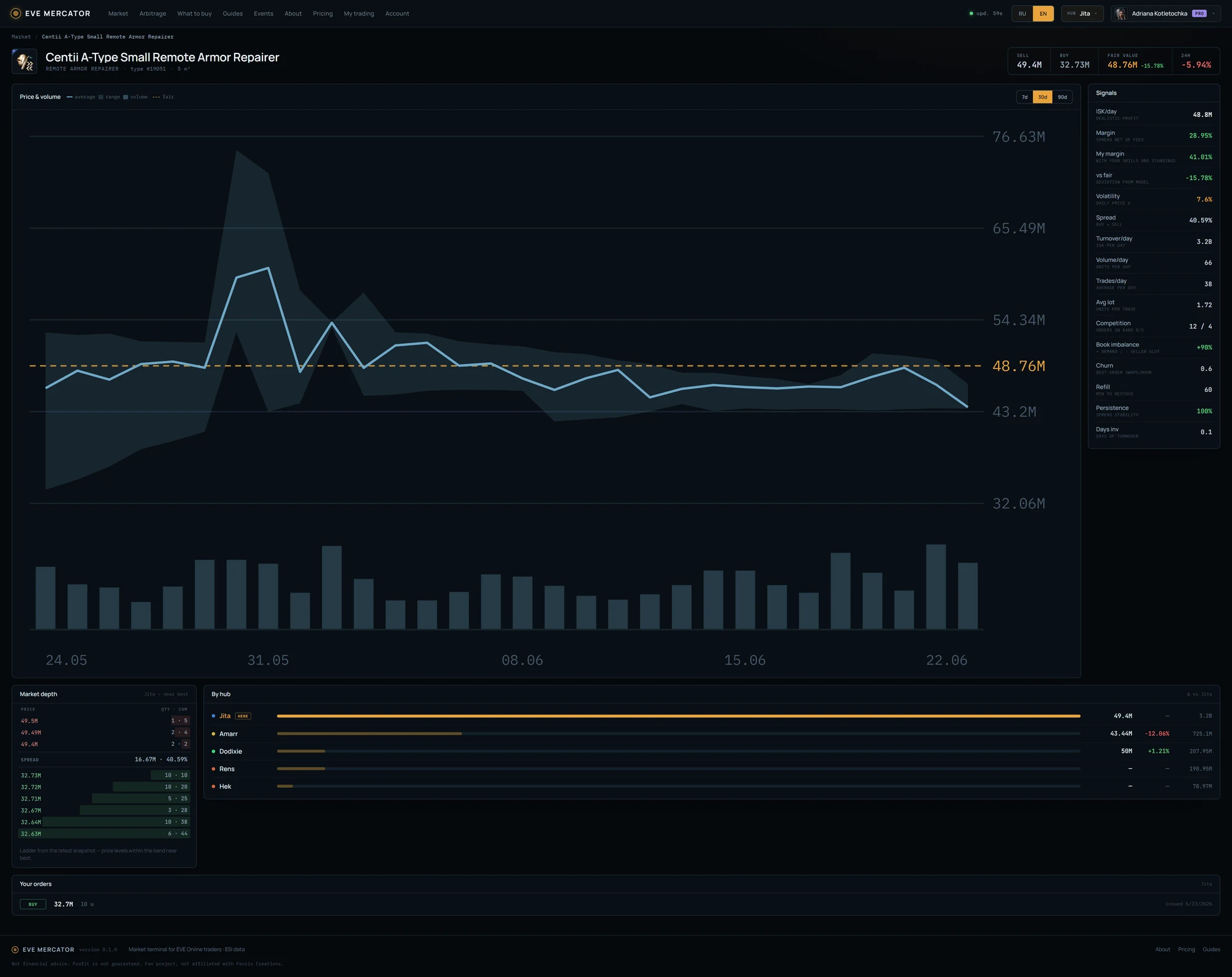
Click an item and the card opens: price history with the fair-value model (the dashed line is the “normal” price), a full signals panel (spread, turnover, volatility, deviation vs fair, spread persistence, churn, refill), order-book depth and a cross-hub comparison. Log in via EVE SSO and “My margin” appears: recomputed from your real skills and standings, not the zero baseline.
Note: “My margin” comes with a plain character login, no Pro required. Free. The entire analytical layer for a single item is open. If you like digging deep into one position, the card gives you everything for it, with nothing to pay.
Inter-hub arbitrage — also free
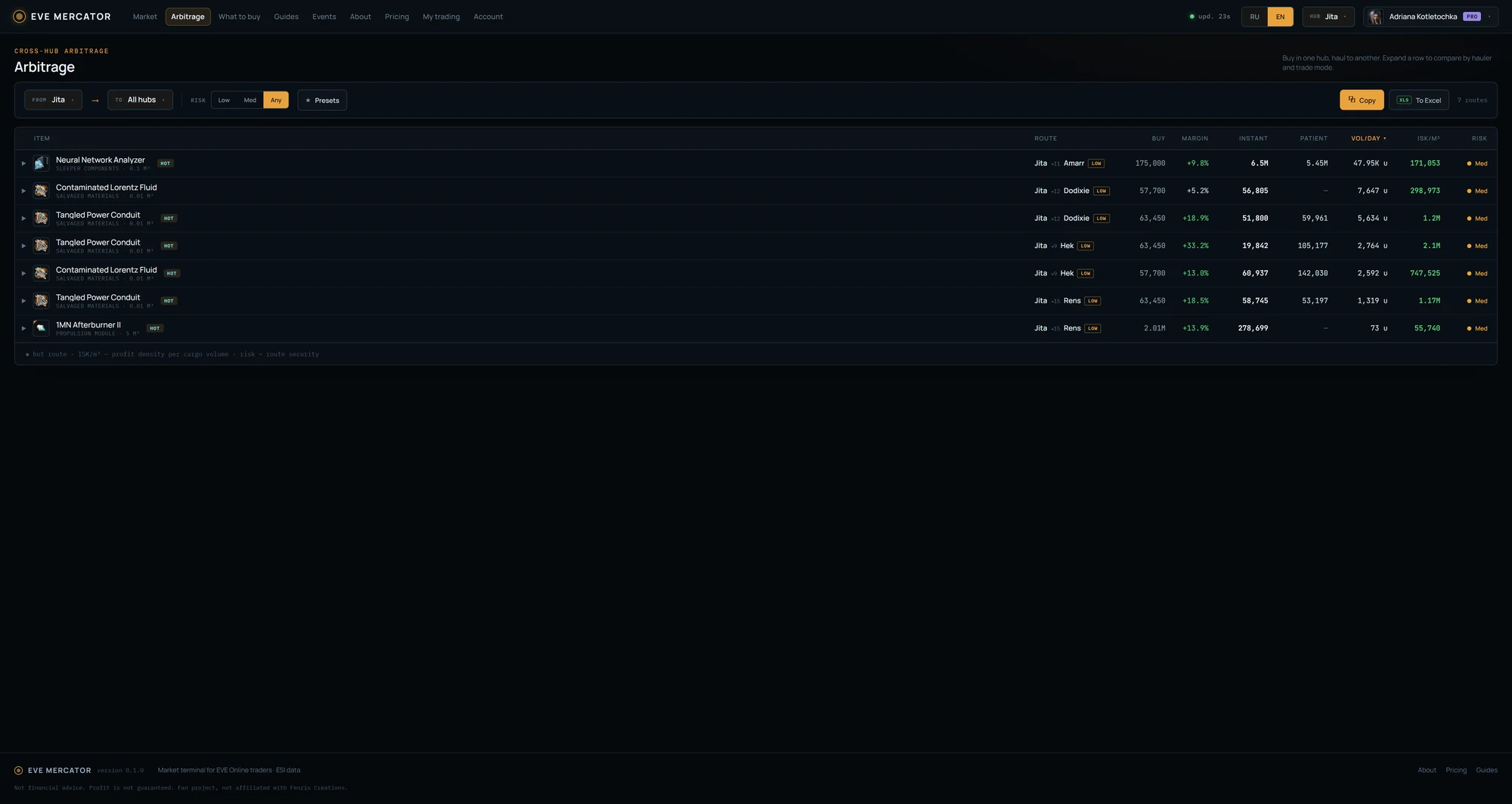
If you’re willing to haul, Arbitrage shows where the same item is cheaper and dearer between hubs, and immediately computes net profit after fees, volume and ISK/m³ for your chosen ship and mode (instant or patient). That’s about hauling, not station-trading laziness, but it’s open to everyone with no paywall — another chunk of “raw data” you can build a route from yourself.
Paid: “What to buy” — the answer is already computed for you
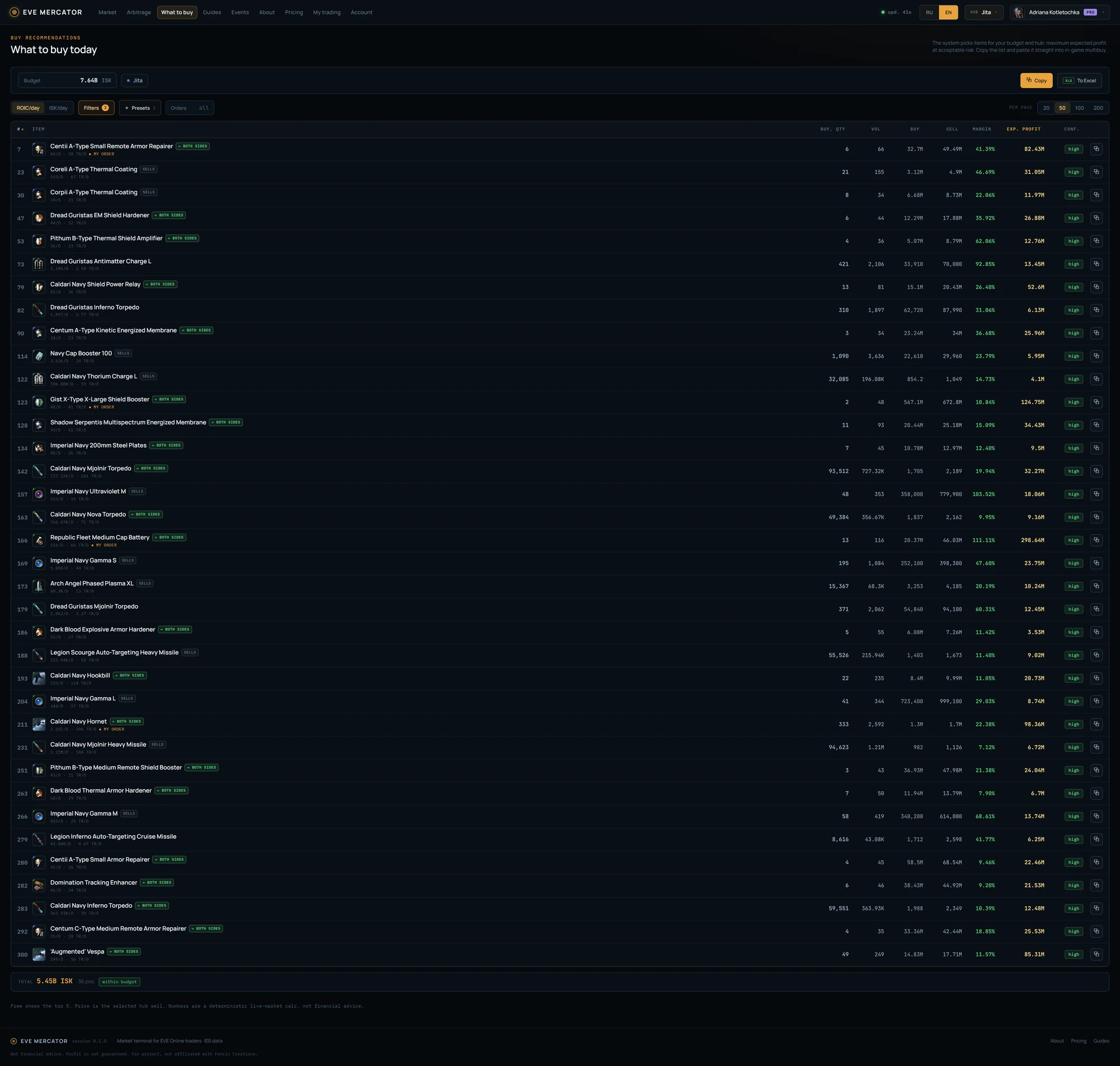
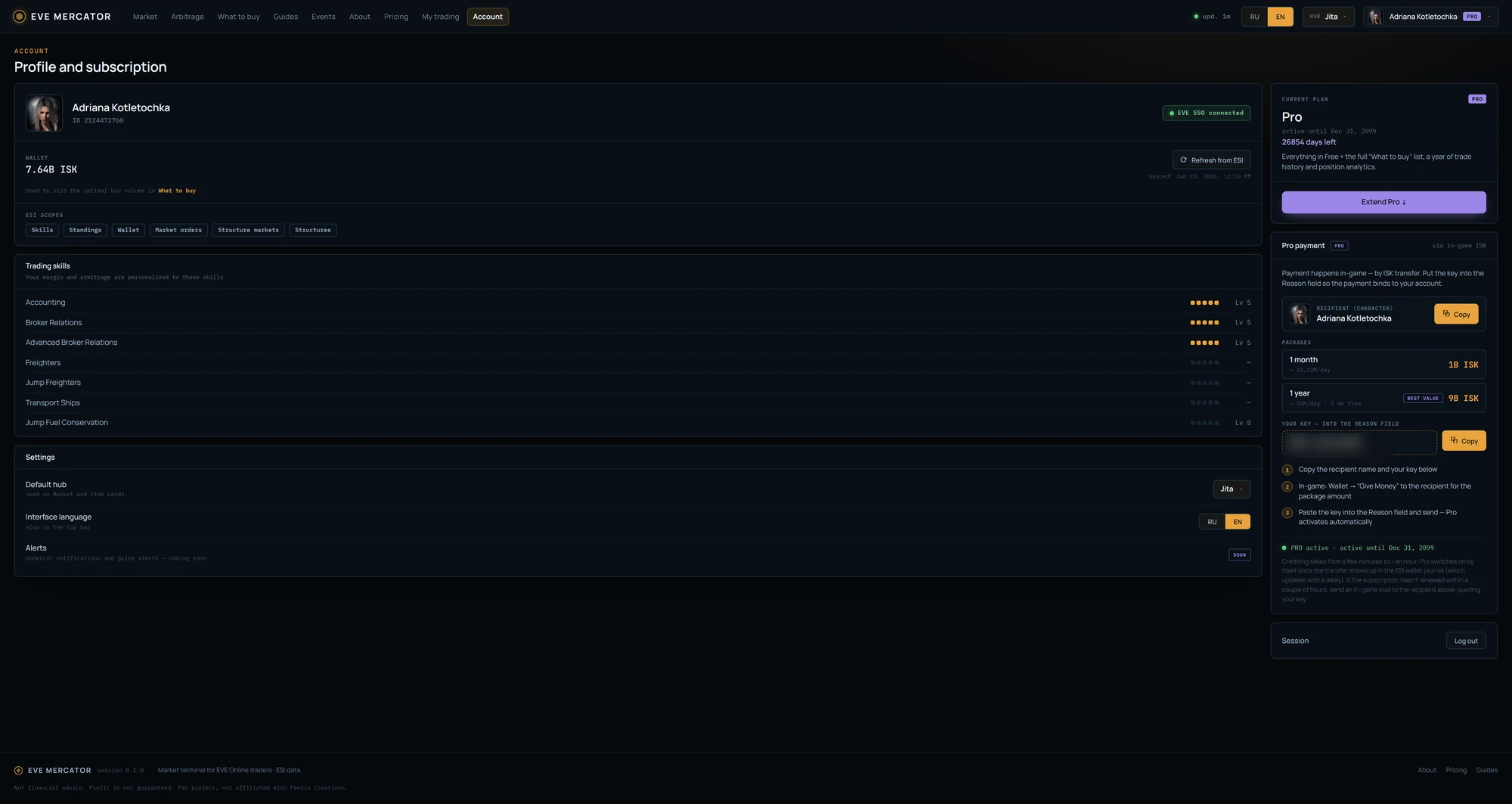
The paid half is exactly one page: “What to buy”. It takes the same free raw data and does all the boring work for you: computes a score (risk-adjusted ROIC per day), filters for live two-sided positions, sizes each position to your budget and concentration limit, and hands you a ready list — “take these, this many units.” The lazy player just copies the names and flips the orders.
And right there is a feature you won’t find anywhere else: order-book skew. The “sales / buys / both sides” badges show how much actually executes via buy and sell orders — something the usual market numbers never reveal. “Both sides” means the flip really closes from both ends; “sales” means the item is being drained, you won’t buy it cheap. There’s a “both sides” filter across the whole list too. This is the difference between “the spread looks fat” and “people actually trade this.”
What free users see — and what the deal actually is
Without a subscription, “What to buy” shows the top 5 positions and a card: “this many more — on Pro.” It’s simply the top of the ready list: the same honest data, the first five shown. Want the whole list, filters over it, and the order-flow skew on every position — that’s Pro.
The deal here is honest and simple. The raw data is free: anyone can open Market and compute it themselves — the answer follows from open data. Pro is a laziness tax: you pay to skip the computing yourself. The price is high on purpose. The edge on this market is real, but it lives only while a handful of people use it; let crowds in and price wars start, and it stops working for everyone. An expensive gate keeps the circle small.
It pays for itself in a couple of days — pure arithmetic
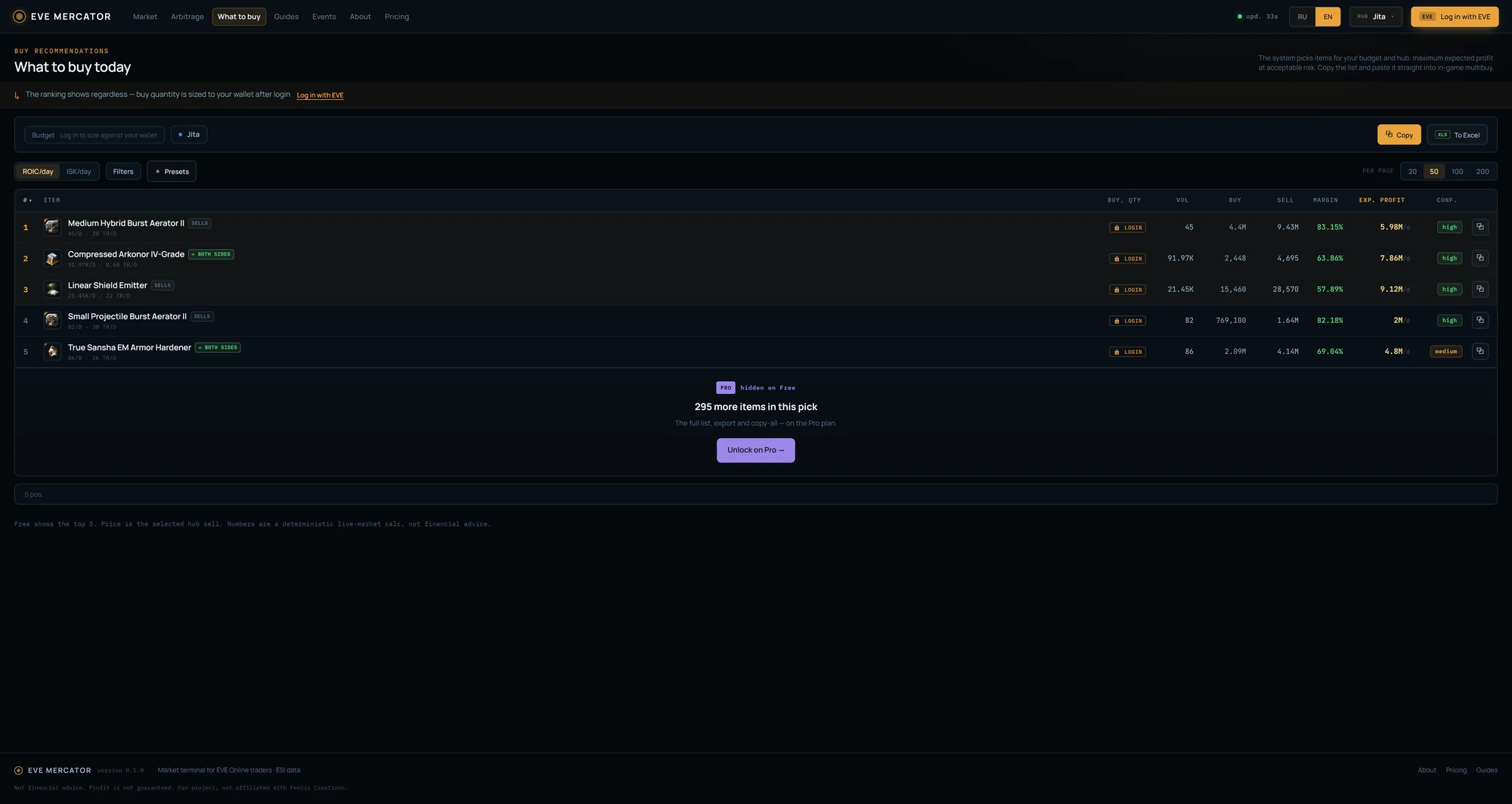
The subscription costs 1 billion a month. On a real account, from a 5-billion start, a few days produced about 2.3 billion net — already after every fee, the broker fee included. One important detail about the screenshot: the “net” column (+112M, +540M, +1.62B, +828M, +492M by day) is shown before the broker fee — that fee sits on a separate line, about 1.25B over the period, and has to be subtracted. Even on this honest, lower figure, a few days of trading cover a couple of months of subscription.
An honest caveat so there are no illusions: the numbers above are on a sizeable bankroll and across a basket of liquid items, not from a single trade or an empty wallet. Small capital means small absolute numbers and a longer payback. Fees are real too (a full cycle eats ~14% at zero skills). But the math is simple: the moment your daily profit clears ~33M (the price of a day’s subscription), Pro is already in the black.
Where the profit comes from: a basket, not one lucky hit
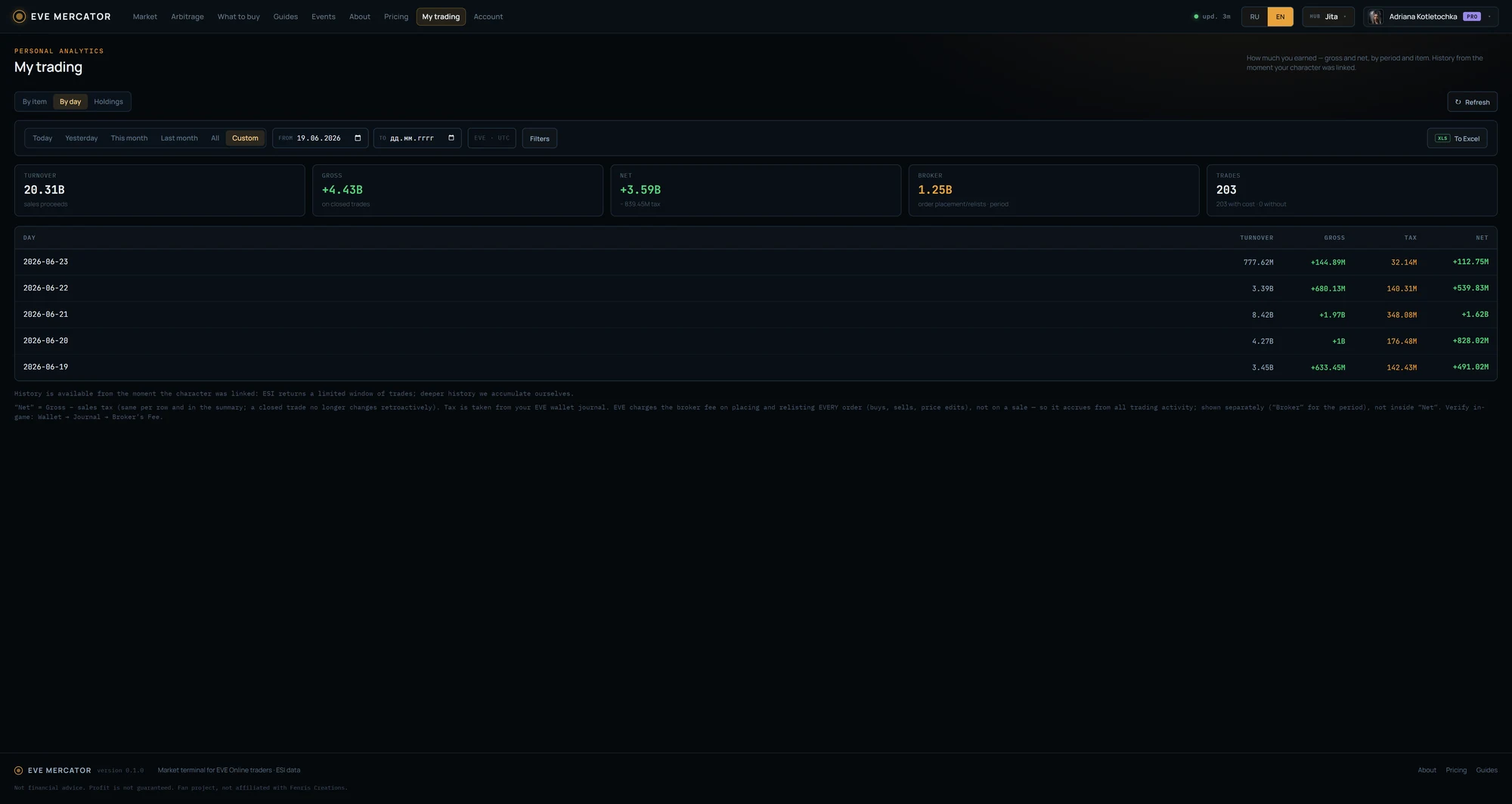
The by-item breakdown shows profit accrues a little from dozens of positions, not from one miracle trade: ~29B turnover, +3.6B “net” over the period before the broker fee (about 2.3B once it’s subtracted), 200+ trades. This is exactly station-trading-by-picks — many small flips on liquid items, not a hunt for a single jackpot. A basket is steadier: one position sags, the rest carry it.
How much capital you actually need
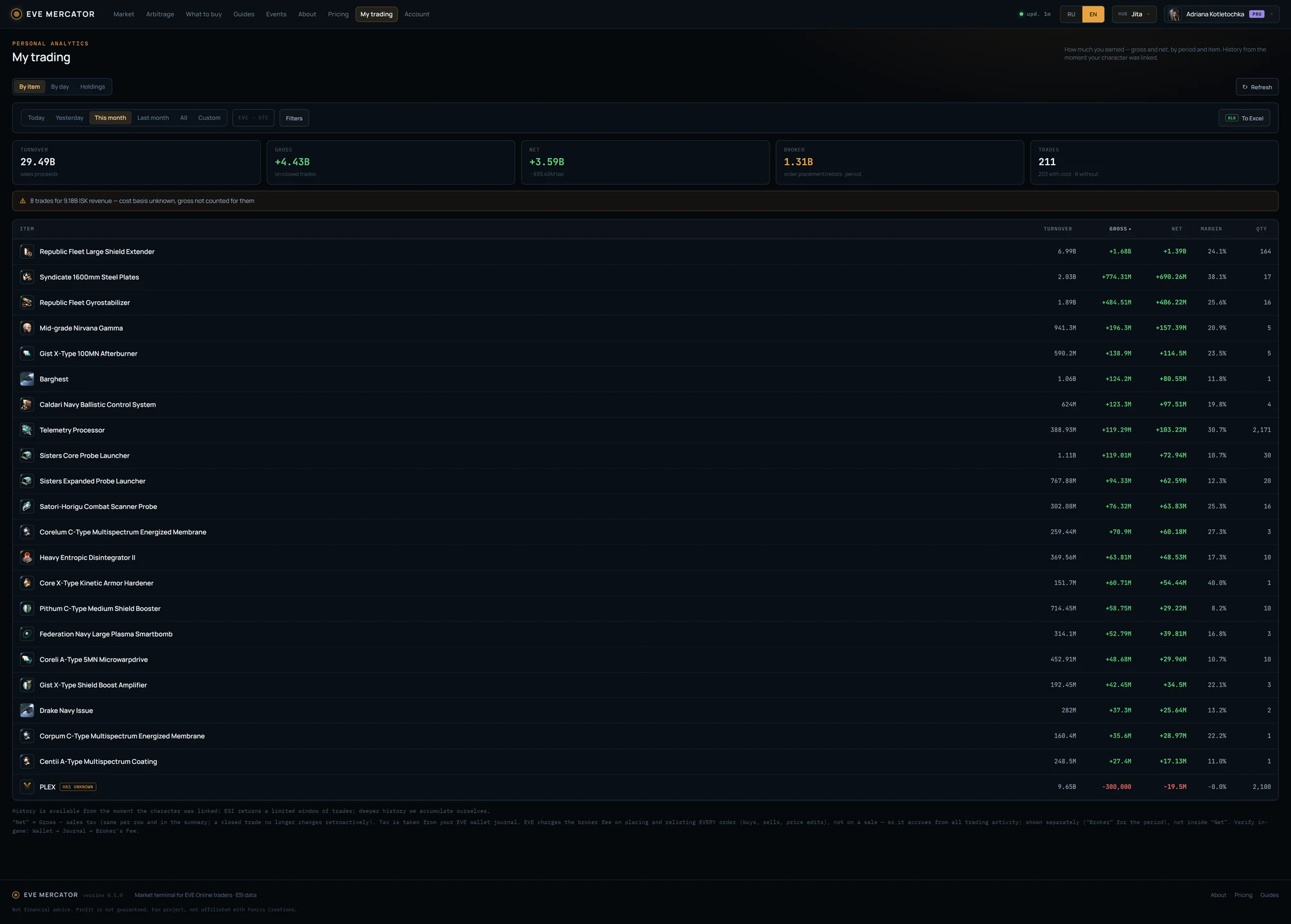
So “you need capital” doesn’t just hang in the air, here are the specifics: everything in the screenshots above was done from a starting stake of exactly 5 billion ISK. Over a few days that five produced about 2.3 billion net — after every fee, the broker fee included. To gauge your own, scale from your capital: twice as much working gives roughly twice the absolute profit.
And about scale right away: by traders’ standards 5 billion is a fairly modest sum. The serious players run 200 billion and up, and for them my service is almost useless: market depth on these items can’t absorb hundreds of billions without crushing your own margin. That kind of capital goes into PLEX and injectors — there the depth allows it, and the thin margin is made up on volume. The sweet spot for the service is roughly from a few billion to a few dozen: enough to turn over, but the market hasn’t hit its ceiling yet.
Why large capital moves into PLEX and injectors →
How to subscribe in a minute
Payment is in in-game ISK, no cards or real money. In Account, copy the recipient name and your personal key, then in-game make a transfer (Wallet → Give Money) to the recipient for the package amount and put the key in the reason field. A small shortfall is forgiven, an overpayment goes toward extra days. The subscription renews automatically within a couple of minutes — no manual confirmations.
There are two packages: 1 billion for a month or 9 billion for a year (three months free). Stacked renewal: you can pay ahead and the days simply add to your current term. That’s it — the full “What to buy” list opens up: copy the basket and flip orders to your heart’s content.
Too lazy to compute? Then don’t
The raw data is free forever. If your time is worth more than evenings over spreadsheets — open the full “What to buy” list, copy the basket, and cover the subscription in a single good day.
FAQ
Why pay for “What to buy” if Market is free?
Because you pay not for the data but to avoid computing it. The raw market data with every metric is open to all — anyone keen can build the basket himself. “What to buy” does that boring work for you: it computes the score, filters for live positions and estimates the size. It is simply a laziness tax: everything is computed from the same open data.
Does the 1 billion per month subscription pay off?
Yes, if you have capital turning over. On a real account, from a 5B start, a few days produced about 2.3B net — already after every fee including the broker fee (in the analytics the “net” column is shown before it, ~1.25B over the period). That is a couple of months of subscription from a few days of trading. On small capital the numbers are smaller and payback is longer.
Why is trading better than grinding and farming?
Income is not tied to hours on screen — orders fill while you are offline — and it scales with capital, not time. Most of all, there is no risk of dying: in station trading you never undock, there is nothing to gank, you do not lose a multi-billion Marauder to a disconnect or a gank.
What is order-book skew (flow direction)?
It is a unique “What to buy” metric: how much actually executes via buy and sell orders, not just the market’s headline numbers. A “both sides” badge means the flip closes from both ends; “sales” means the item is being drained and you will not buy it cheap. It helps tell a live trade from a good-looking but dead spread.
Who is this service for, and who is it not for?
For lazy players with capital who are tired of grinding and want to flip orders without effort. Not for trade whales with trillions (they have their own tools and trade PLEX), nor for newbies and PvPers with no ISK — a billion-a-month subscription makes no sense for them.
How much ISK do you need to trade from the picks?
It starts working from a few billion. The screenshots in the guide were made from a starting stake of exactly 5 billion ISK — a few days produced about 2.3B net after every fee including the broker fee. Profit scales with capital: twice as much turning over means roughly twice the absolute. Hundreds of billions won’t fit, though: market depth can’t absorb them, which is why large capital trades PLEX and injectors.